モーツァルト
ピアノソナタ第13番 K.333。
この曲を色で表すとしたら、
私はずっと「白に近い金」だと思っていた。
派手ではない。
誇示もしない。
でも、確かにそこに在る光。
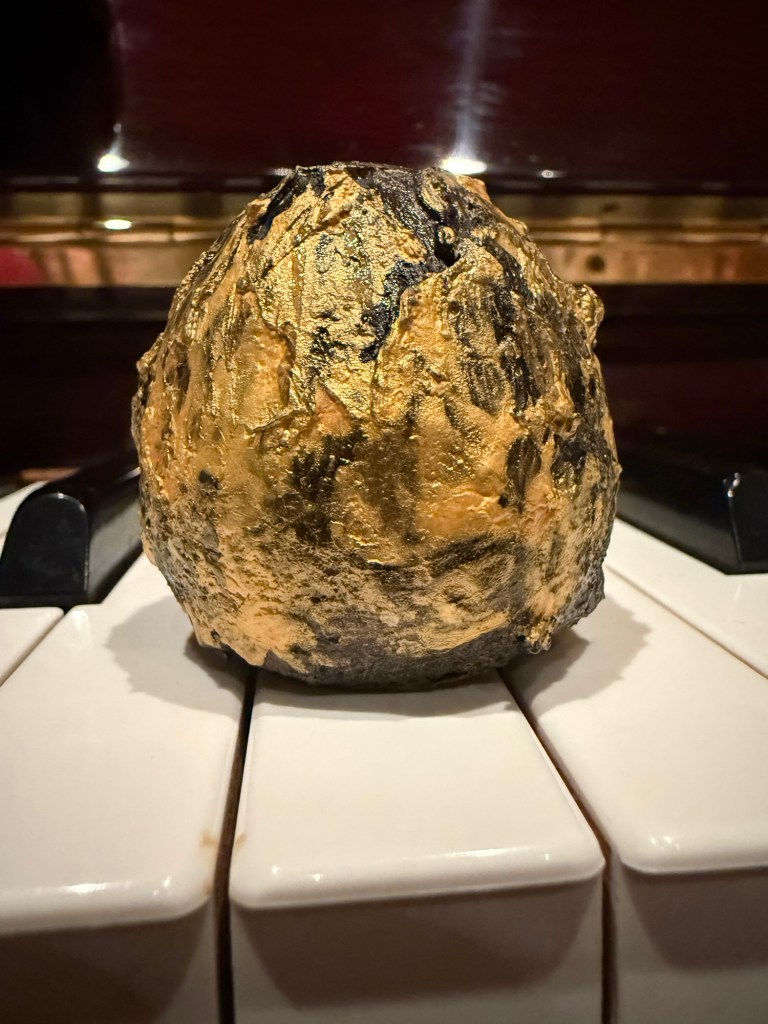
そのイメージから生まれたのが、この桃です。
金は主役ではありません。
むしろ黒や影の方が多い。
形式や沈黙、時間の重さがまずあって、
その上に、ところどころ金が触れている。
旋律のように流れるのではなく、
時間が触れた痕跡としての金。
特に第2楽章
Andante cantabile。
感情を語りすぎないのに、
なぜか心の奥に残るあの感じは、
甘さではなく、
「甘さが通り過ぎたあと」に近い。
これは、
モーツァルトを色にした桃ではなく、
音楽が沈黙に変わった時の色
なのかもしれません。
演奏が終わったあとも、
部屋に残っている何か。
それを、
桃というかたちで置いてみました。
[English]
February 2nd: Mozart K.333 — The Color When Music Turns to Silence
Mozart, Piano Sonata No. 13 in B-flat major, K. 333.
If I were to describe this piece in color, I have always thought of it as a “gold close to white.” Not flashy. Not showing off. But a light that is certainly there.
This “Momo” (Peach) was born from that image.
The gold is not the protagonist. Rather, there is more black and shadow. There is form, silence, and the weight of time first, and upon that, gold touches in places. Not flowing like a melody, but gold as the traces where time has touched.
Especially the second movement, Andante cantabile.
It doesn’t speak too much of emotion, yet that feeling that remains deep in the heart is not sweetness, but rather “what remains after sweetness has passed.”
This is perhaps not a peach that turns Mozart into color, but the color of music when it transforms into silence.
Something that remains in the room even after the performance has ended. I tried to place that “something” here, in the form of a peach.
[Français]
2 février : Mozart K.333 — La couleur de la musique devenant silence
Mozart, Sonate pour piano n° 13, K. 333.
Si je devais exprimer cette pièce par une couleur, j’ai toujours pensé à un « or proche du blanc ». Pas d’ostentation. Pas de vanité. Mais une lumière qui est certainement là.
C’est de cette image qu’est né ce « Momo » (Pêche).
L’or n’est pas le protagoniste. Au contraire, le noir et l’ombre dominent. Il y a d’abord la forme, le silence et le poids du temps, sur lesquels l’or vient se poser par endroits. Non pas comme une mélodie qui s’écoule, mais comme une trace laissée par le temps.
Surtout le deuxième mouvement, Andante cantabile.
Il ne dit pas trop d’émotions, et pourtant, ce sentiment qui reste au fond du cœur n’est pas de la douceur, mais plutôt « ce qui reste après que la douceur soit passée ».
Ce n’est peut-être pas une pêche qui met Mozart en couleur, mais la couleur de la musique lorsqu’elle se change en silence.
Quelque chose qui demeure dans la pièce, même après la fin du concert.
J’ai essayé de déposer ce « quelque chose » ici, sous la forme d’une pêche.
[中文]
2月2日 莫扎特 K.333 —— 音乐化为沉默的颜色
莫扎特
钢琴奏鸣曲第13号 K.333。
若要用颜色来形容这首曲子,我一直觉得那是“接近白色的金”。不张扬,不炫耀,但这光芒确实存在。
这个“桃(Momo)”便是由此意象而生。
金并不是主角。反而是黑与影更多。首先存在的是形式、沉默与时间的重量,在此之上,零星点缀着金。它不像旋律般流淌,而是时间触碰留下的痕迹。
特别是第二乐章 Andante cantabile。
它并未过多诉说情感,却莫名地留在心底深处。那种感觉不是甜美,而更接近“甜美逝去之后”。
这或许不是将莫扎特化作颜色的桃,而是音乐化为沉默时的颜色。
演奏结束后,仍残留在房间里的某种东西。
我试着将其以桃的形式留存下来。
#MomoInThePalm #Mozart #K333 #PianoSonata #Sculpture #Art #ContemporaryArt #Urushi #LacquerArt #Kyoto #TaroMizushima #Momo #水島太郎 #彫刻家 #現代アート #桃 #モーツァルト #ピアノソナタ #漆 #脱乾漆 #沈黙の色 #アトリエやま #てのひらにももを

